I headed off to Emmaville today to see the mining museum.
The first thing I noticed when I stepped out of the car was that the town smelled like sheep. It wasn’t a bad smell, though – it was the kind of lanolin smell that clean wool has.
The museum is less about the techniques of mining but rather the fruits of it – it has several rooms worth of geology. Prepare for a lot of photos of what I liked best, and the corresponding explanations. Even if you don’t care about the science, I promise you most of them look very pretty.
First up, some fossilised stromalites:
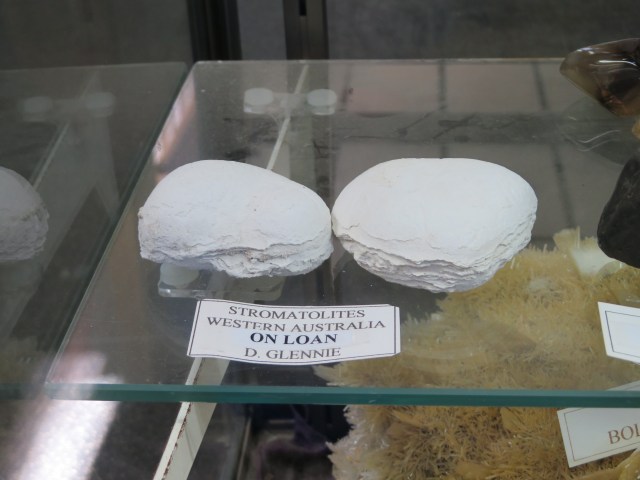
Stromalites are solid structures created by cyanobacteria, and are the earliest evidence of life in the fossil record.
Petrified coal:
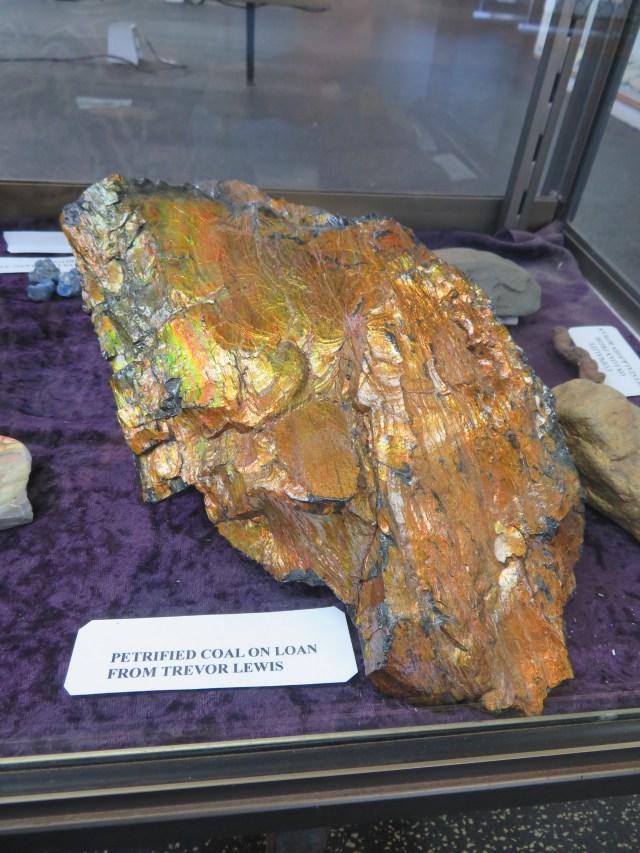
Most people have heard of petrified wood, in which the organic material of the wood has been replaced with minerals, turning it into a fossil. It might sound funny, but coal can petrify just like wood.
Obsidian:
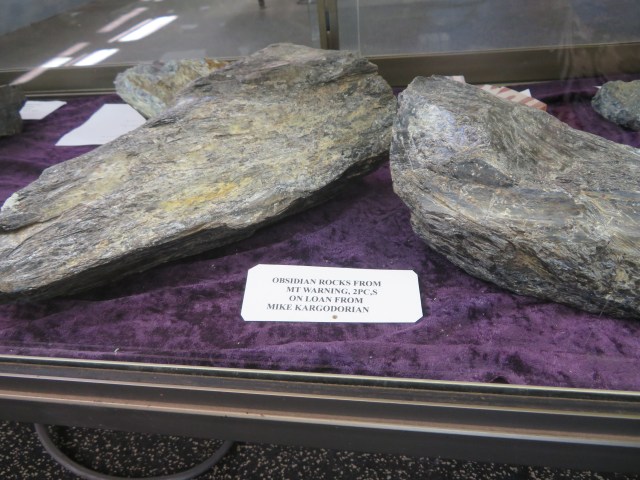
Obsidian is formed by volcanoes. Specifically, when lava that is rich in the lighter elements (like silicon and aluminium) cools rapidly with minimal crystal growth. It’s known for being hard and brittle, and fracturing into very sharp edges.
Speaking of volcanoes, this is a volcanic fossil of a plant:
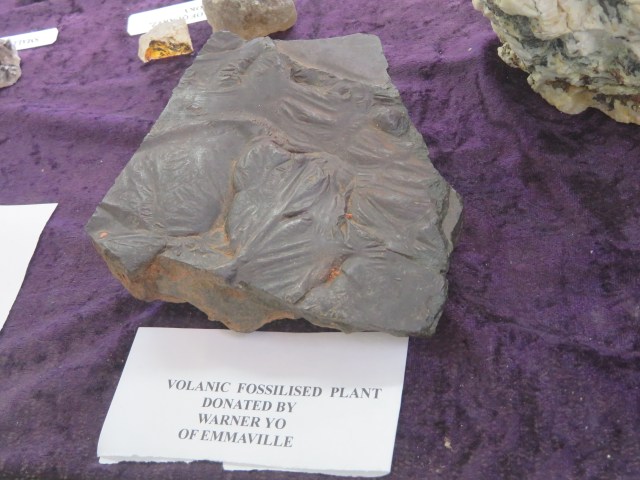
Volcanic fossils are formed when the ash from an erupted volcano falls in a heavy sheet and buries organisms beneath it. Think Pompei.
These are called vertebrae:
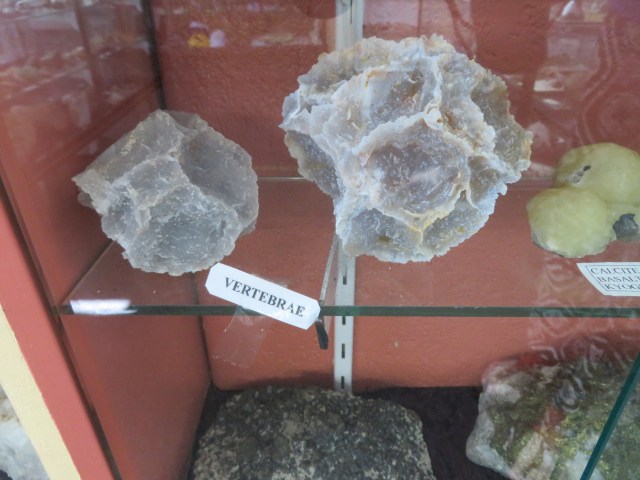
They’re well-named, aren’t they? The first time I saw I wondered what they were, and thankfully one of the curators of the museum explained it to me. You know thunder eggs? The ones that look a geode? This is the internal silica structures with the surroundings rock stripped away.
Snowflake obsidian:
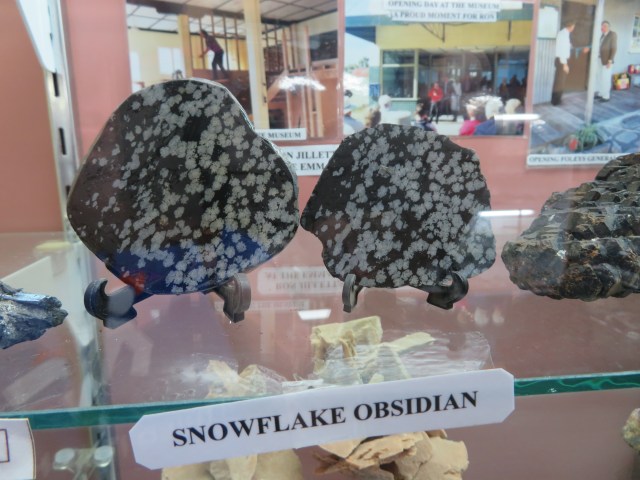
As a ‘glass’, obsidian is chemically unstable. In time, it begins to crystallise, and these ‘snowflakes’ are formed.
Opalised wood:
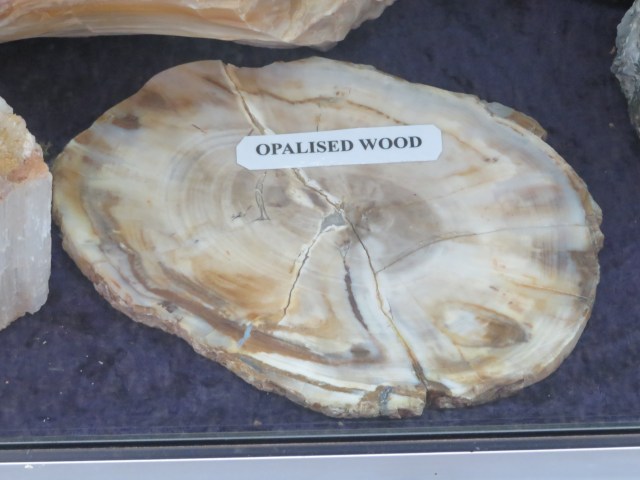
Yes, you read that right – this wood isn’t merely fossilised, it’s opalised. Opal starts as a solution of silica in water, carried into cracks and crevices in a sturdier rock. The water evaporates, leaving behind the silica deposit (though some water remains in opal, anywhere between 3% to 21%). The internal structure of the silica molecules and the percentage of remaining water molecules determine how it diffracts light, which is why it comes in such a range of colours (and why precious opal is so famously rainbow-hued).
Australia has a lot of opal – about 95% of the world’s supply – and is the only place in the world where you can find opalised animal fossils.
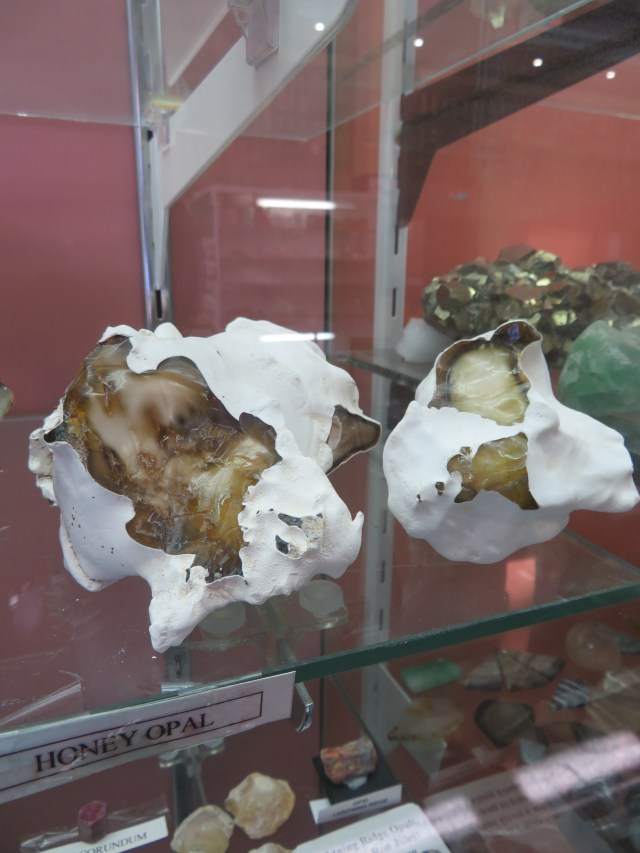
Speaking of different shades of opal, this variety is called honey opal, for obvious reasons:
Rainbow titanium:
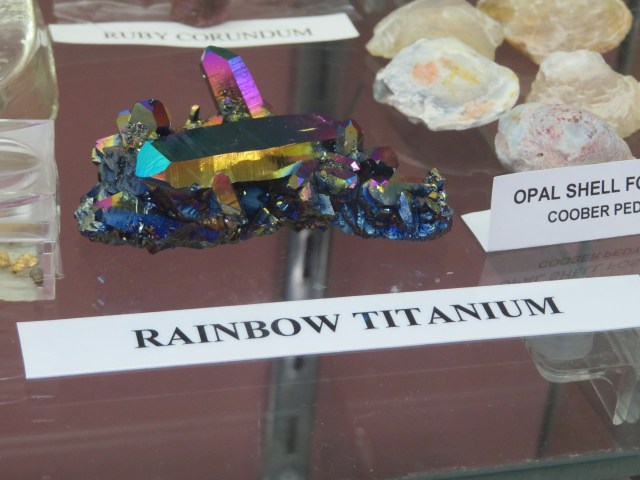
This is actually quartz, the surface of which has been coated by titanium. The layers produce an optical interference effect, which is what makes all those colours.
Gold:
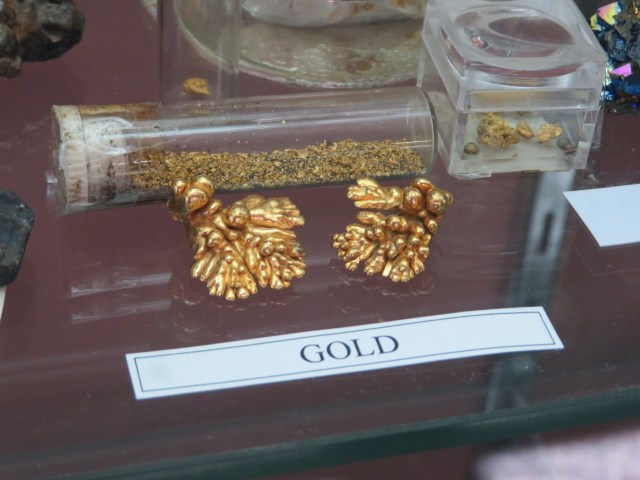
As a pure element, gold is created inside massive stars when they go supernova. The gold that was present when Earth first formed sank into the iron core along with the other heavy elements – every bit of gold that human beings have found has arrived later, likely carried on asteroids.
Petrified wood:
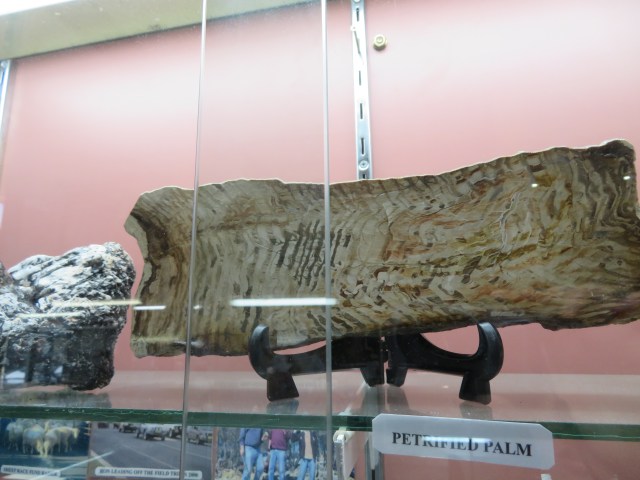
Now this is petrified wood – of a palm tree, to be exact.
Shell fossils:
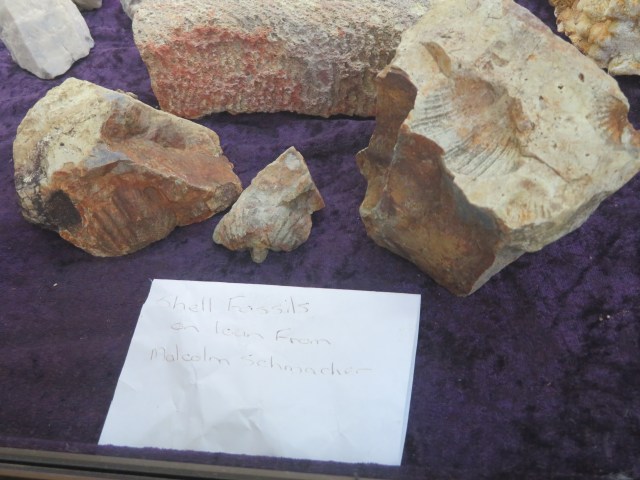
I’ve already told you how fossils are formed – minerals replacing organic matter, if you need a reminder.
Blue granite drill core:
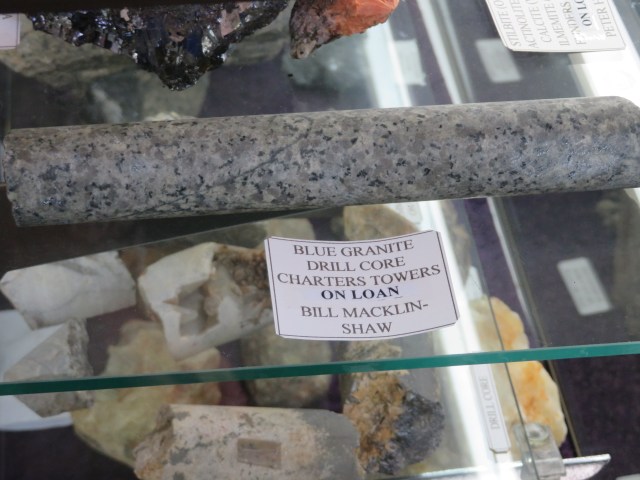
A core drill is a drill specifically designed to remove a cylinder of material. This particular cylinder is blue granite. Granite is formed through the solidification of lava which has a high proportion of quartz and feldspar – the feldspar formations are what give the granite its colour.
Volcanic glass:
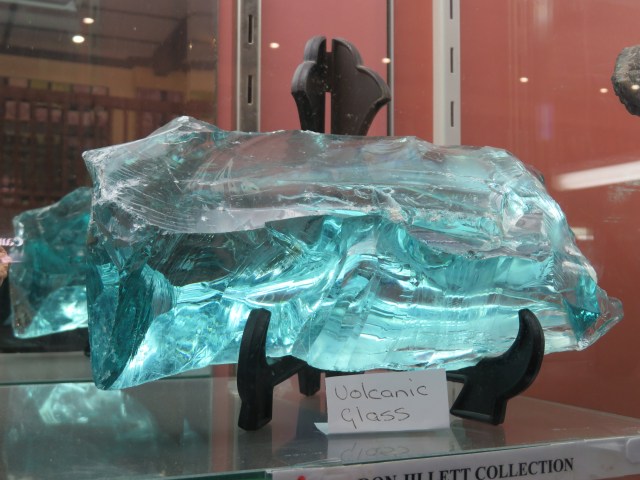
This is a product of rapidly-cooling magma that has a chemical composition close to granite. When the magma has a high viscosity (basically how sticky and slow-moving a liquid is) it can reach a low temperature without crystallisation, and a sudden cooling will turn it to glass rather granite.
Glass is unstable and tends to change from glass to the crystalline state in a short period of time (by geological standards) so there are no truly ancient samples of volcanic glass.
Fossil fenestella:
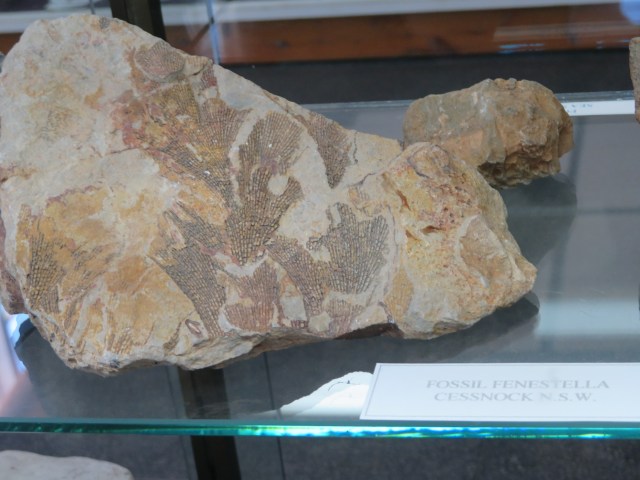
Fenestella is a genus of aquatic invertebrates similar to coral. They became extinct in the Triassic period.
Fossilised wood grub:
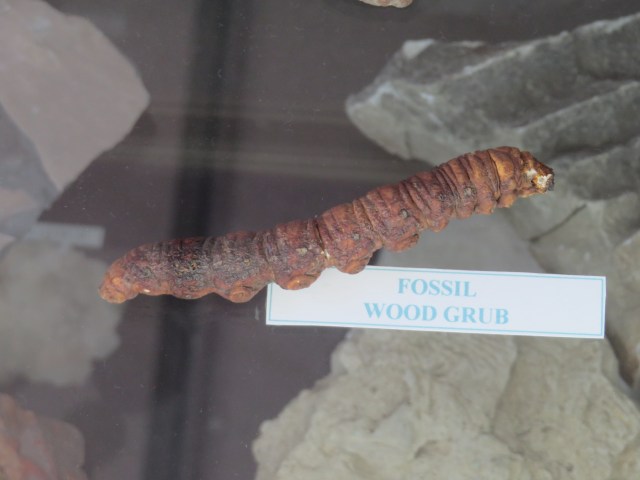
Not much of an explanation to give for this one, is there?
Fossilised Murray cod:
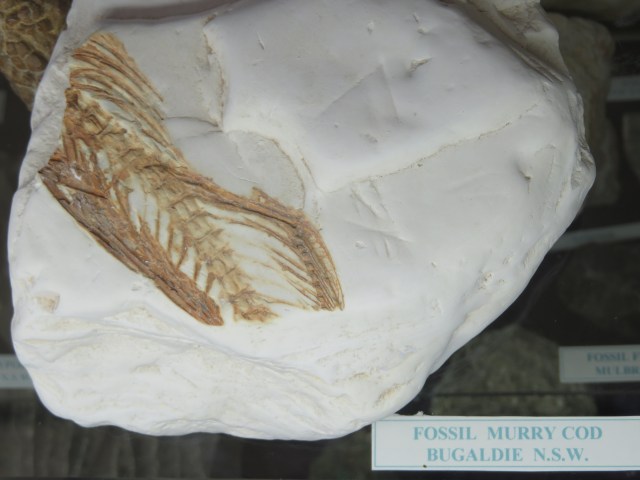
Nor for this one.
Fossilised fish:
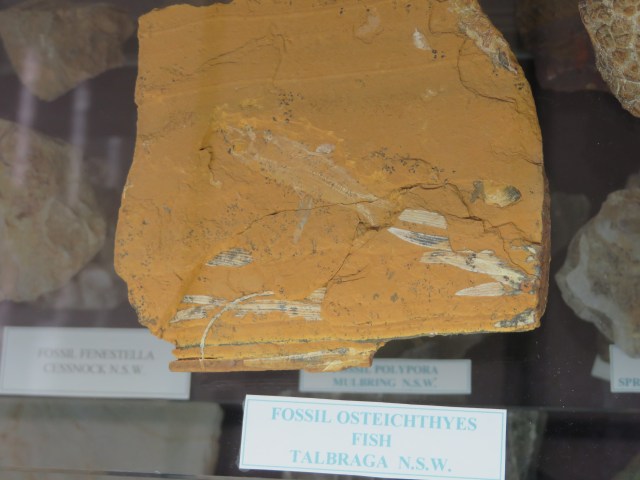
The most classification they gave these fossils was that they were osteichthyes – fish with a bony skeleton.
Fossilised weevil cocoons:
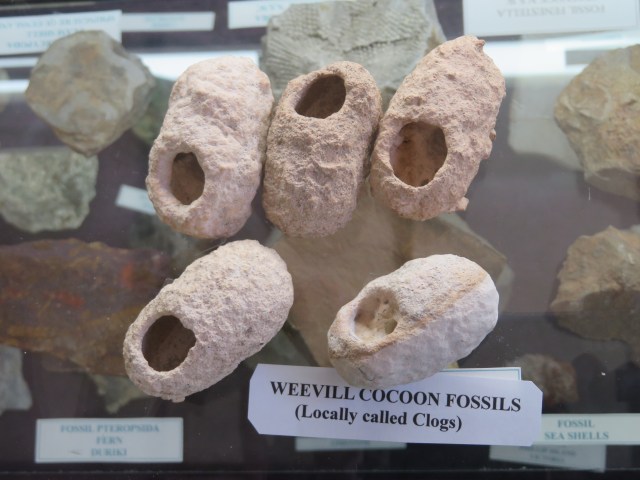
Weevil larvae don’t spin a cocoon to pupate – they make a cell in the earth. Which clearly fossilises very well. I just love that people call them ‘clogs’, because they do kind of look like them, don’t they?
Boulder opal:
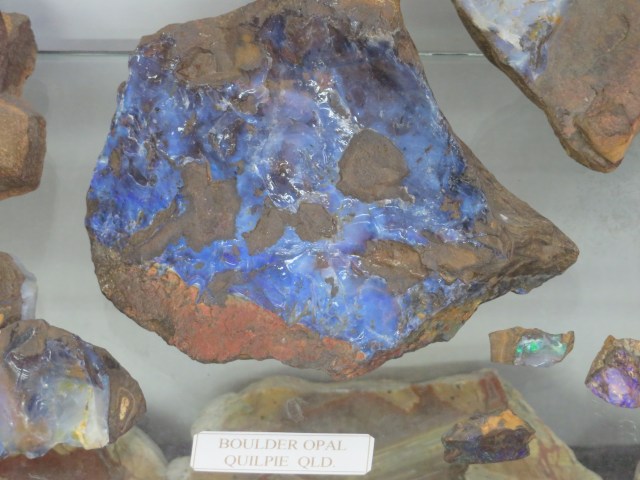
This makes it easy to see how the silica-rich water that forms opal was following little cracks in the rock.
Azurite:
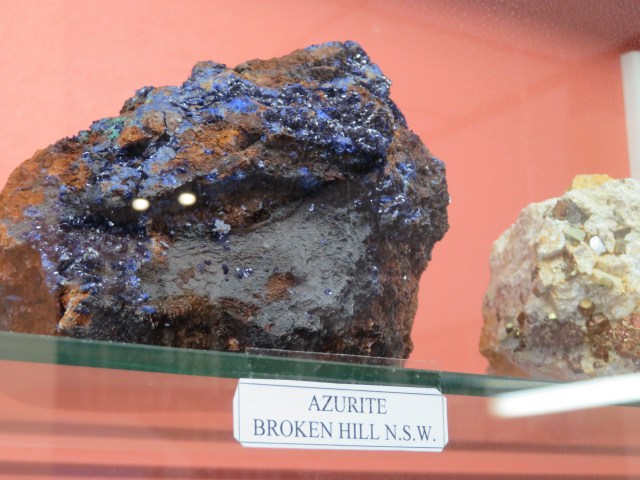
This is actually a form of copper, bonded to carbonate and hydroxide.
Tiger iron:
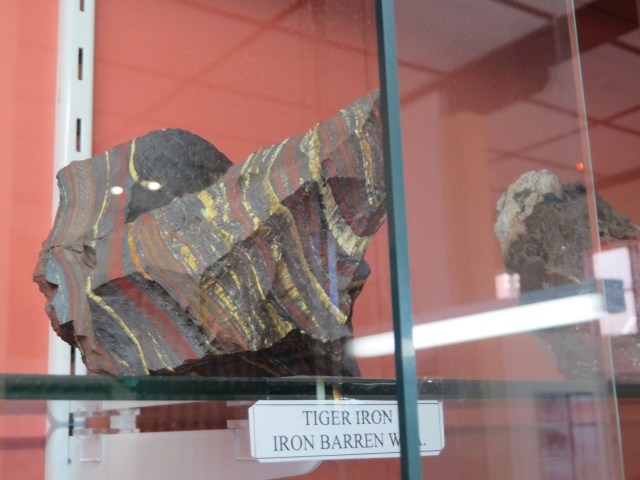
Tiger iron is composed of tiger’s eye, red jasper, and black hematite. Tiger’s eye is a metamorphic rock – a rock transformed by heat – and a member of the quartz group. Jasper is an impure variety of silica, usually with iron which gives it a red colour. Hematite is an iron ore, specifically an iron oxide.
Together, they make a pretty nice pattern.
Red obsidian:
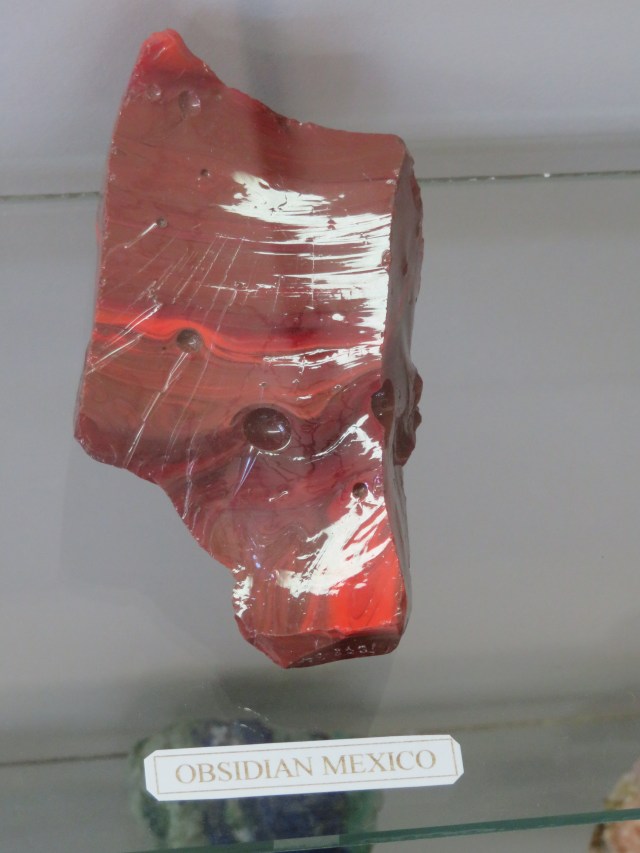
Obsidian is usually black, but this red colour probably comes from the presence of iron in the lava.
Pudding stone:
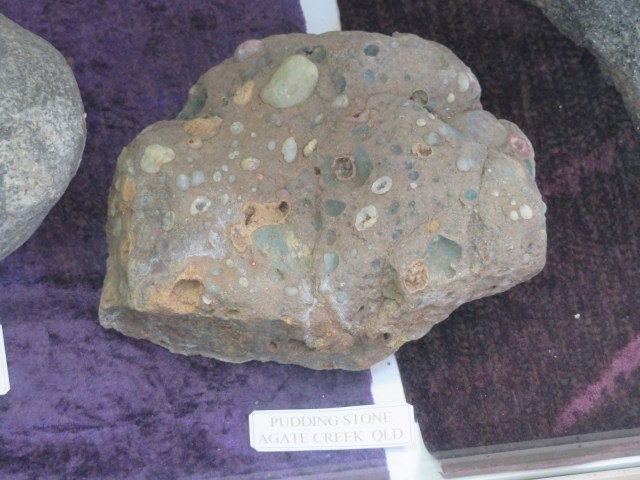
This is a conglomerate – basically the kind of rock that forms when gravel, via compaction and evaporation of water, turns into rock. In pudding stone, you have to be able to see distinct pebbles contrasting with the ‘cement’ surrounding them – like a Christmas pudding.
Cycad fossil:
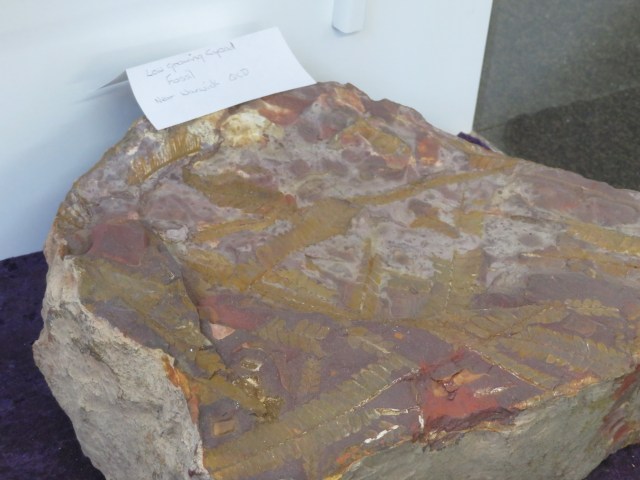
Cycads are seed plants with a stout, woody trunk and a crown of large, stiff leaves. Basically, think of the fern-trees you see in dinosaur movies – those are cycads. And they’re still around today.
Meteorites:


It’s pretty weird to think that these are space travellers. Solid pieces of…something that came from outer space and managed to survive falling through the atmosphere.
Septarian nodules:
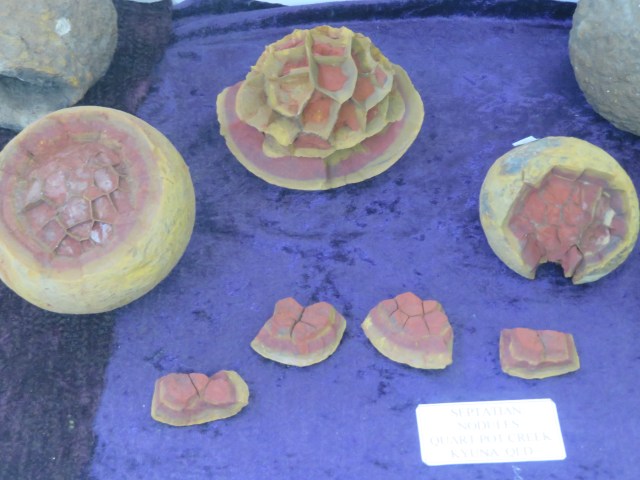
So for this to form, first what happens is called concretion. That’s when mineral cement precipitates between particles of rock or soil, forming a hard, compact mass. Septarian nodules are when the concretions contain angular cavities or cracks.
Chickens feet and a thunder egg:
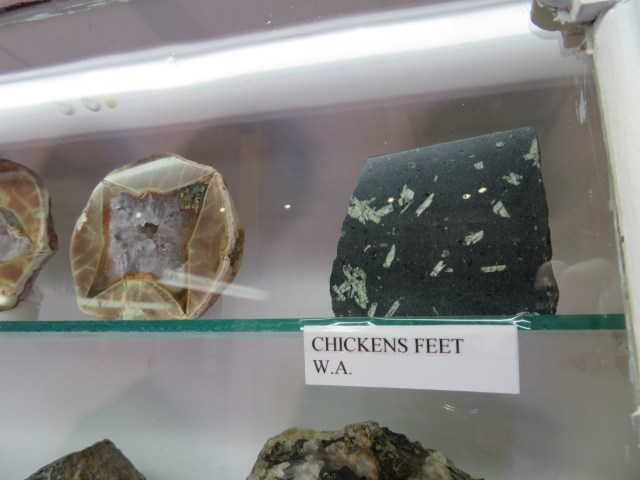
I just loved the name of that one. And that’s a thunder egg beside it – they form when gas pockets in silica-rich lava act as moulds for water carrying the silica. Remember the vertebrae? That’s where they’re from.
Impression of a drill:
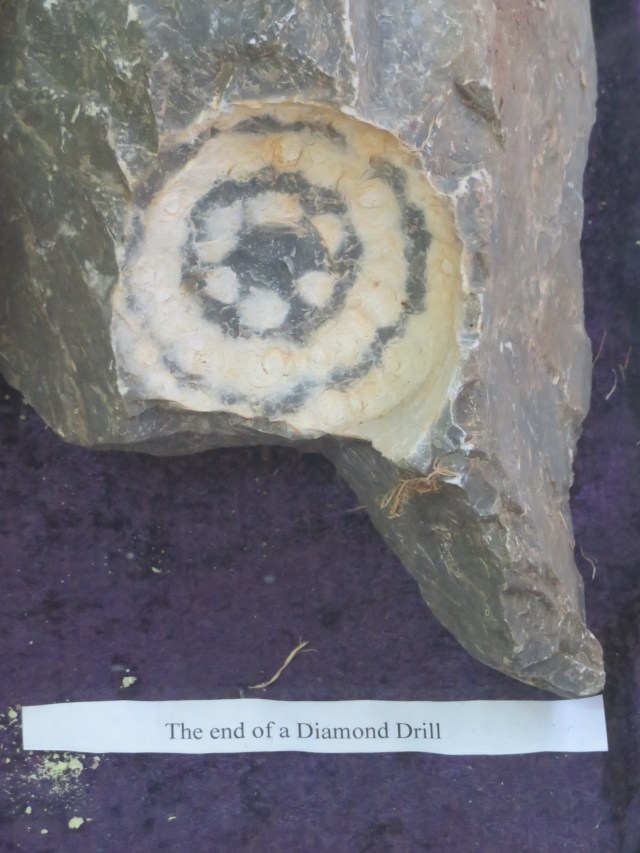
Remember that drill core? That’s the mark of what extracts it – a diamond drill.
Grass stone:
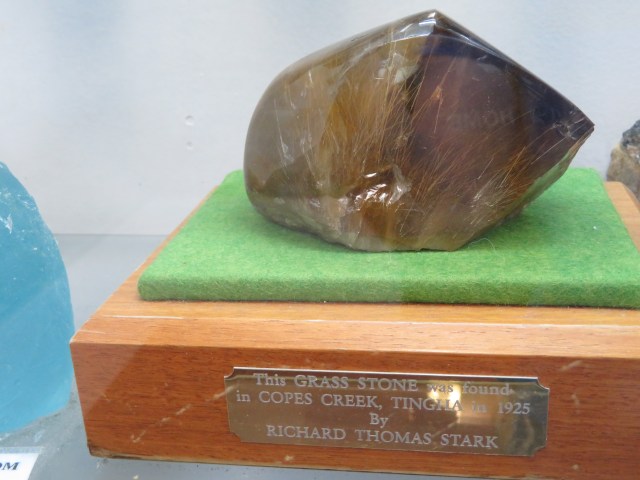
This is quartz with needles of rutile, a mineral composed mainly of titanium dioxide. It looks like there’s long, thin blades of grass inside the stone, hence the name.
Opalised seashell:
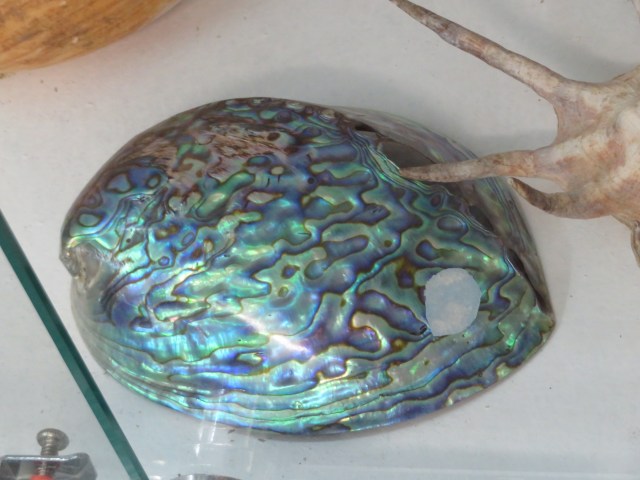
I’ve told you about the opalization process already, but this was too pretty not to take a photo of.
Chalcopyrite:
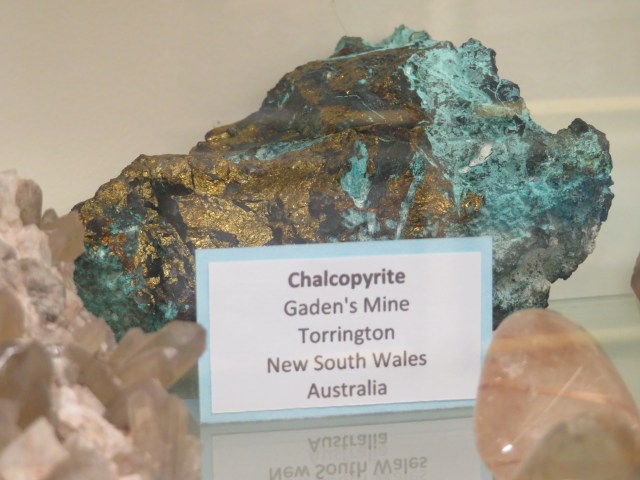
Copper iron sulphide. The green/blue colour is the copper, while the gold colour is from the iron sulphide, also known as fool’s gold.
Zebra stone:
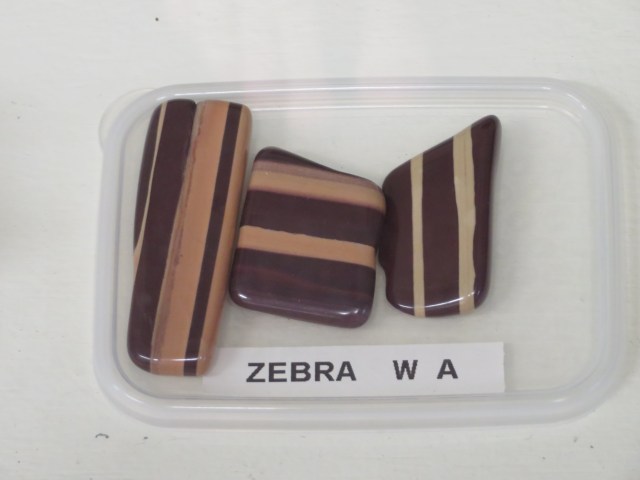
Brown and white banded sedimentary rock, found only in Western Australia. There’s still no explanation of how the regular patterns were formed, but it is known that zebra stone was deposited about 600 million years ago, in the Precambrian era.
Asbestos:
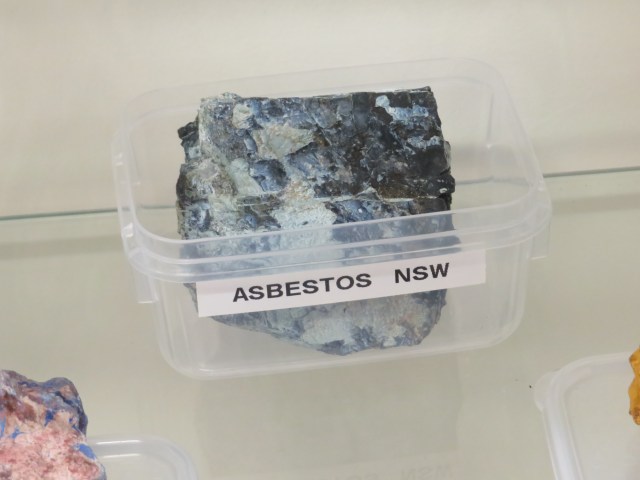
Don’t worry, this isn’t hazardous. Asbestos is the name of six naturally occurring silicate minerals – it’s only once you process them that they get dangerous.
Peacock copper:
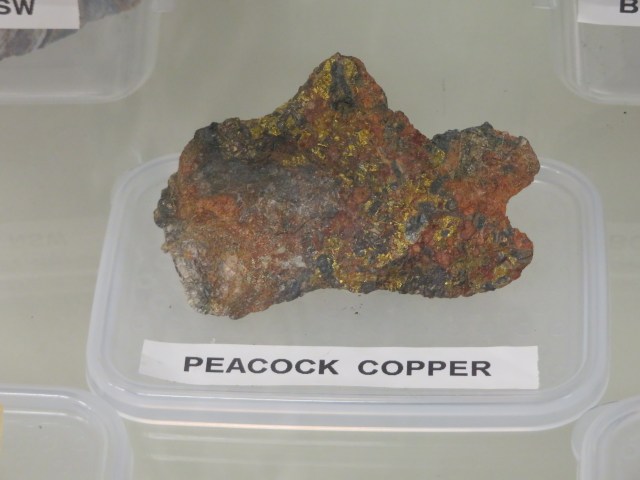
Properly called bornite, it’s actually a mix of copper, iron and sulphur.
Ribbon stone:
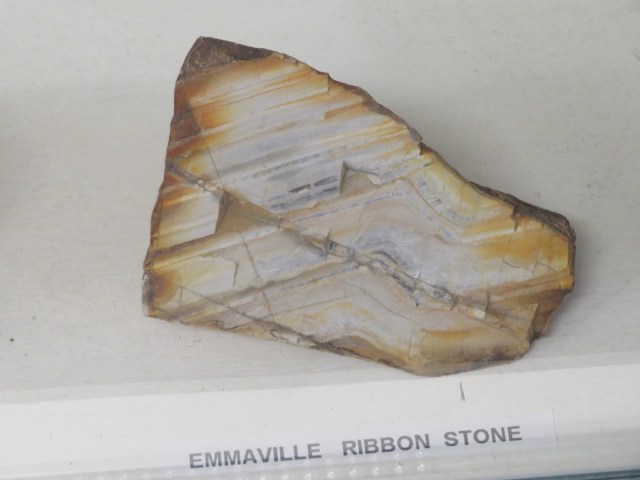
Basically zebra stone with more flexibility in the colours. Again, it was deposited at least 600 million years ago, and again, ribbon stone is only found in Australia.
Diprotodon fossil:
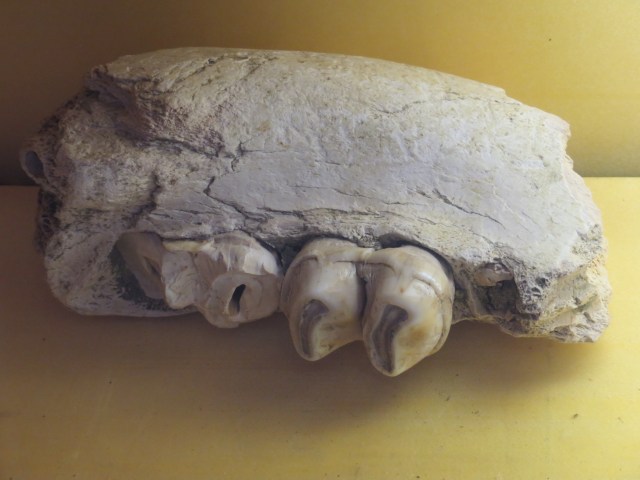
Diprotodon is the largest known marsupial to have ever lived, and was about the size of a hippopotamus. It became extinct about 46, 000 years ago.
Jelly bean quartz:
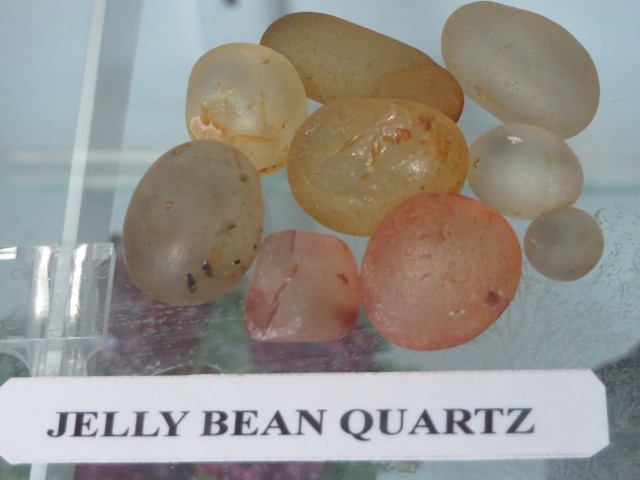
Another name I love. It’s also known as water worn crystal, and is exactly what you’d think – quartz that was smoothed and rounded by water.
They also had an old general store set up:


I found some familiar names:


I also found these amusing displays:
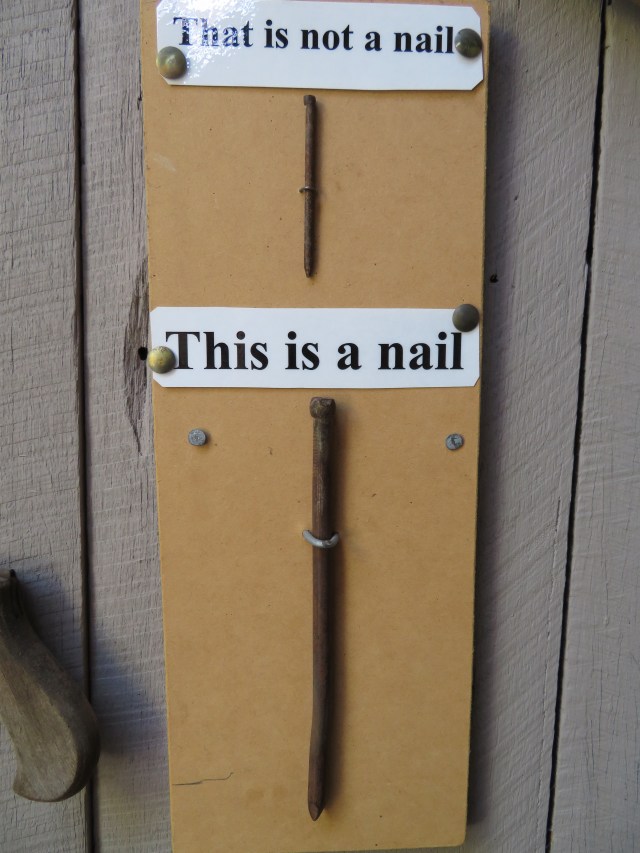
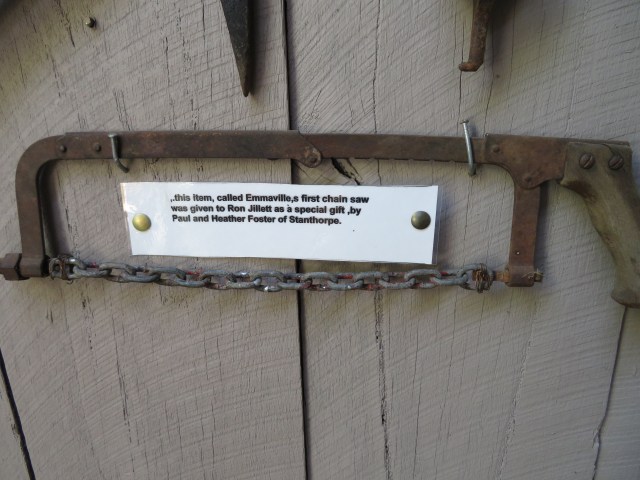
There was a very extravagant bottle collection as well.


When I left the museum, there was a lot of birdsong in the air, so I had a look around. I managed to spot some Diamond Firetails, and got a video of one of them:
There was a Welcome Swallow on the power line:
And I also found a pair of eastern rosellas, looking like they’re making out:
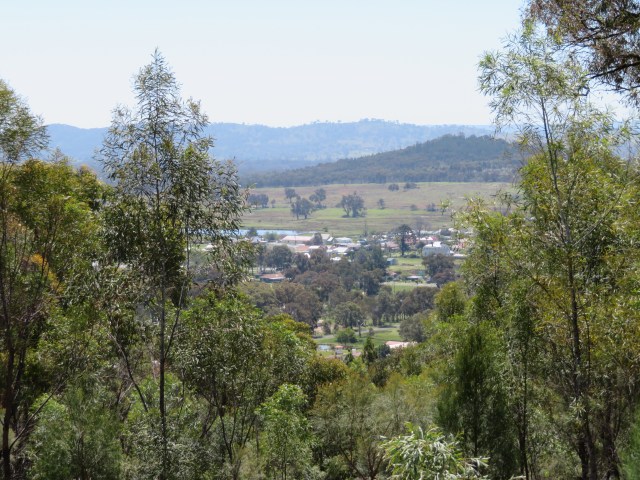
On the way back, I saw a sign promising a lookout and followed a little road up to an area that had a power station, a picnic table, and a lovely view. Emmaville, from above:
Then it was back to Glen Innes. I stopped off on the way at a place called the Super Strawberry, a little shop on a strawberry farm.


I admit I checked them out purely because I liked their name and logo. Hey, there are worse reasons to visit places. I got one of their strawberry milkshakes – made with real strawberries – before I went back to Turtle Shell.
 Jenny's Adventures
Every time I read your blog I’m jealous! Great pikkies, lots of fun things to see and do! Loved the info about the rocks, and the NAIL!!
LikeLike
I was pretty amazed at all the rocks myself – I’d tell you which was my favourite, but I honestly can’t pick one (and I liked the ‘chainsaw’).
LikeLike
Chainsaw also v good. I told someone about that yesterday!
LikeLike
I love the way you “scienced the sh*t out of it”
LikeLike
The museum was amazing! I was particularly interested in zebra stone and ribbon stone – only found in Australia, the process that forms them is still a mystery…I don’t know, it’s like the Riversleigh fossils near Mt Isa, you just want to demand ‘why doesn’t everyone know about this?’
LikeLike