Prepare for some animal photos (and stories).
There’s always wildlife on the farm, so here are some of the more interesting ones I managed to get photos of. They’re mostly birds, mainly because rabbits and hares don’t really stay still long enough to get a good shot of them.
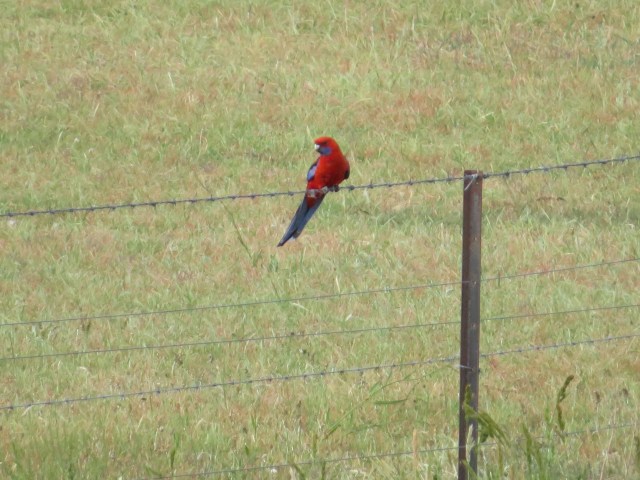
First up, a crimson rosella, just chilling on the horse paddock fence:
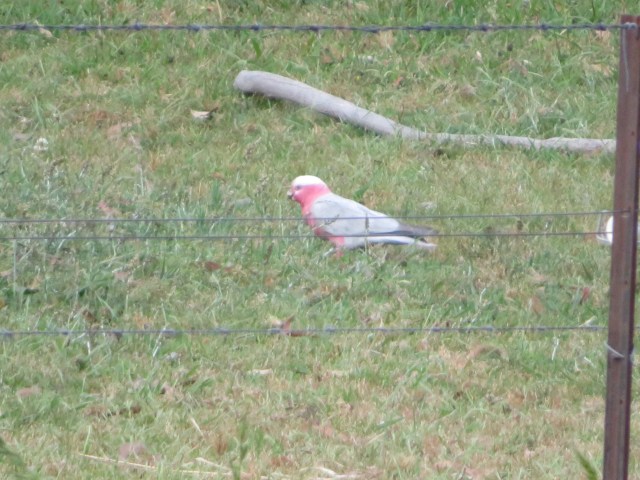
A galah foraging in the paddock:
A family of wood ducks staying very still and hoping we won’t notice them:
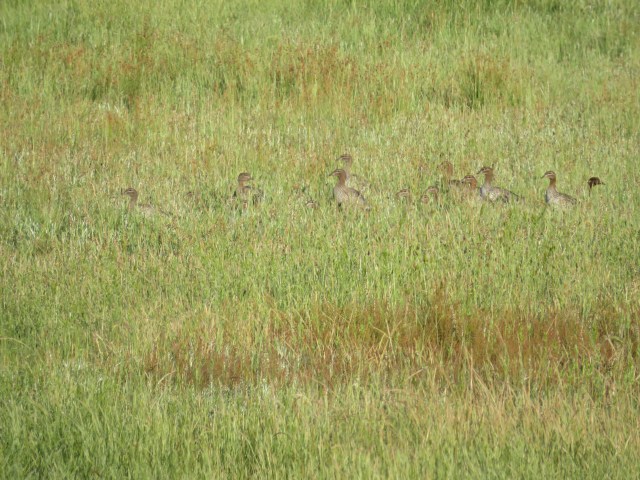
No luck, ducks – we saw you! Though it is pretty good camouflage, especially against animals that don’t see as many colours as we do.
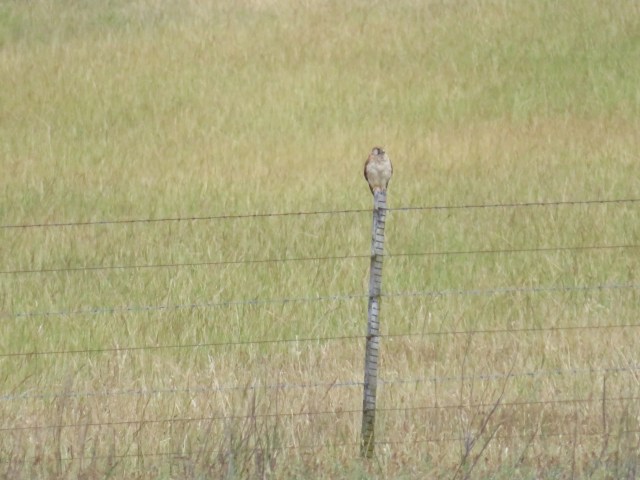
This, I spotted on a distant fence post – an Australian kestrel.
This is a video of it flying away. Not a very good video, but I’m offering it up nonetheless:
And the most exciting one was spotted early one morning as Aunty Sandy and I drove out to play with the horses – a wedge-tailed eagle:

We saw a pair of them flying, and this one helpfully landed in a bare tree so I could get some good photos. I took a few close-ups as well:


Then it took off.
Now, our actual story begins when Aunty Sandy and Martin went to the Hunter Valley, so I was charged with checking on Nipper. I drove out on the first day, and Nipper was very happy to see me, probably because he now associates people with food. I fed him, topped up his water, and then set off home.
On the way home, I found a turtle in the middle of the road. I pulled over to move him to the verge, but it seemed to be in a bad way – it was slow to react. It was also very dry – usually when you pick turtles up, water tips over the lip of their shell, but this one was bone dry. Around this time is usually when they migrate to another water source, and some of them can pick a bad direction and die before they reach new water.
This was where I picked it up – as you can see, there’s no water around:


I was rather impressed it made it this far. So, what could I do? I decided the turtle had to come with me:

I settled it on my lap, then I turned around and drove back to the farm. But not all the way to the house – I pulled over beside the first dam:
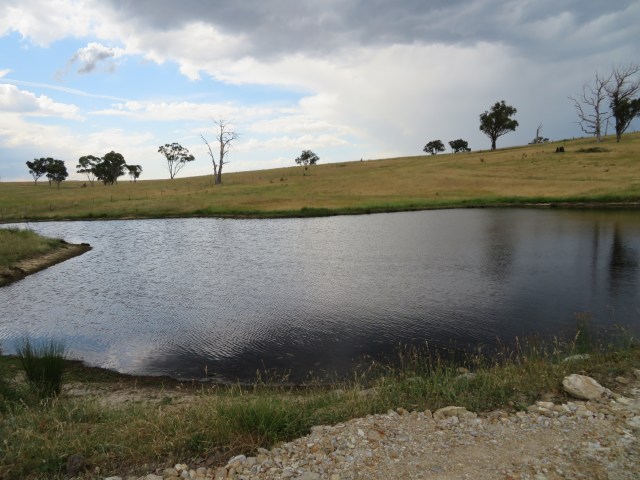
And that’s where I left it:
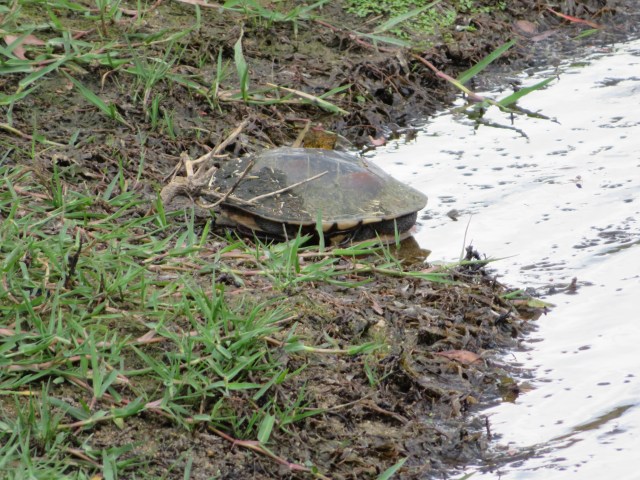
I figure that counts as a migration, right? And if it’s not happy with this dam, there’s plenty of others within easy distance, even for a turtle.
Then I left again, looking forward to getting home to Turtle Shell after that brief diversion. Only it appeared my work wasn’t over yet – I only got a little further before I spotted a duckling in the middle of the road. I pulled over so I wouldn’t hit it, and waited for it to cross. Instead, it ran down the road, away from the car, cheeping loudly. I expected to see it veer off and join a mother and siblings in the long grass, but it never did. And it didn’t seem to be running well, either – it would walk and then trip, like it was newly-hatched.
I hopped out of the car and walked after it, ready to sprint back if an angry mother came at me. But nothing happened.
At this point, I realised the baby was alone. I had nothing to pick it up with, so I took off my shirt to grab it – I’m sure I made am amusing sight, chasing down a baby bird in my bra. When I picked it up I realised it wasn’t a duck – it’s feet were webbed, yes, but only partially, its beak was small and sharp, and it had a very long neck.
So now, I’m standing in the middle of the road in my bra, with a chick of…something…in my shirt and I’m wondering how I’m supposed to drive back and keep the little thing under control – it was very energetic and wiggly.
This was my solution:

I opened up the little tray between the driver and passenger seats, put my hat in there to approximate a nest, then put the chick in my hat and closed the lid to stop it jumping out. I fully expected to be washing my hat afterwards, but it was a good passenger and didn’t poop in it.
When I got back to Turtle Shell, I took the large green bucket that usually holds my hoses and filled it with cloths and a plate of water. Apparently, it shouldn’t be something deep enough for them to swim in because when they’re this young they have no waterproof feathers and also can’t really regulate their own temperature, so if they get too wet they can develop hypothermia.
Not that the little one paid attention to that. Here it is, playing in the water:
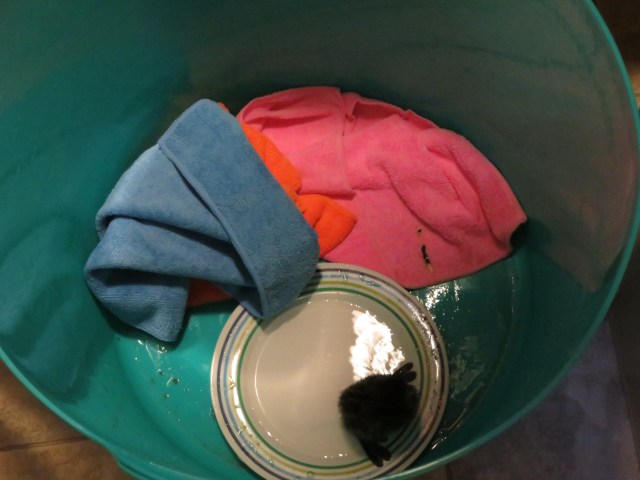
You can see that while it’s feet are slightly webbed, it’s nothing like a duck’s.
Here’s some close ups:


As you can see, it was very small and fluffy, so it might have been a late hatching. That’s when most of the eggs have hatched and the mother (and father, in some species) leads the brood away, but due to weakness, a thick shell, or just plain bad luck, one or two eggs hatch much later. At this point, the parents and the other chicks are too far away to hear the baby’s cries, and the chicks usually just wander randomly until a predator finds them.
Now that my guest was comfortable, I called the wildlife carer for the area. She tried to get someone out immediately, but they were short-staffed, so I said I wouldn’t mind taking care of it until tomorrow. She gave me some instructions, and we puzzled over what species it was together. It turns out I had found an Australasian Grebe.
They’re mainly carnivorous – fish and water insects – so for dinner I took out some sliced chicken breast from the fridge then chopped it up very fine, like worms. The chick gobbled them up, and actually stopped cheeping, which was a relief, as I had been wondering how I was going to sleep with it cheeping all the time. I covered the bucket with a towel, hoping it would just go to sleep.
Just as I was thinking it had worked, it started up again! I tried feeding it, but it wouldn’t take the chicken, and when it hadn’t stopped by the time I was getting ready for bed, I was beginning to seriously regret saying I could take care of it until the morning. The wildlife carer had told me to give it a hot water bottle overnight (again, because of that ‘not good at regulating their own temperature’ thing), so I filled my hot water bottle, wrapped it in a tea towel, then put it into the bucket. And to my surprise (and relief), the chick snuggled up to it and promptly fell asleep. I put the towel over the bucket, and went to bed.
I was woken up in the middle of the night by a renewal of the cheeping. I checked in on the little guy, and found the hot water bottle had gone cold, so I refilled it and the chick settled down quite happily.
The wildlife carer turned up at Turtle Shell in the morning, and I handed the grebe chick over. Fortunately, no days since have been quite so eventful.
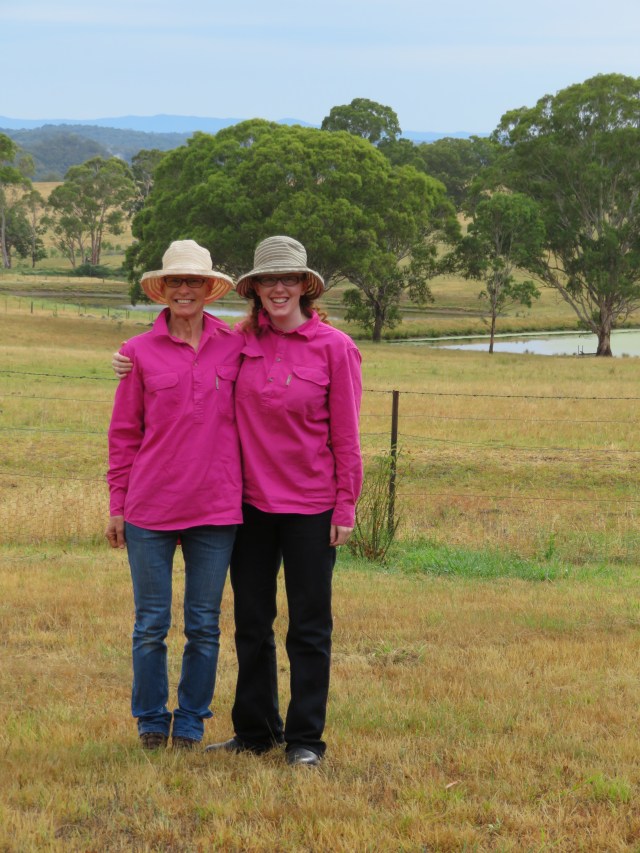
Now, for some random updates. Aunty Sandy and I have been doing lots of work with the horses, me with Missy and Aunty Sandy with Flash now that Nipper’s out of commission. One day we noticed we’d worn almost exactly the same clothes, like we were wearing a uniform, so we took a picture.
I give you, the Victoria Park staff uniform:
Now for an update on the injuries. Mine have completely healed, with only a bit of pink skin to mark where they once were:


Nipper still needs his dressings, but the wound has shrunk quite a bit:

Still doesn’t look nice, but much better compared to what it was, and he’s walking perfectly fine on it. He’s also trotting and cantering, so it doesn’t seem to be hampering his mobility in any way.
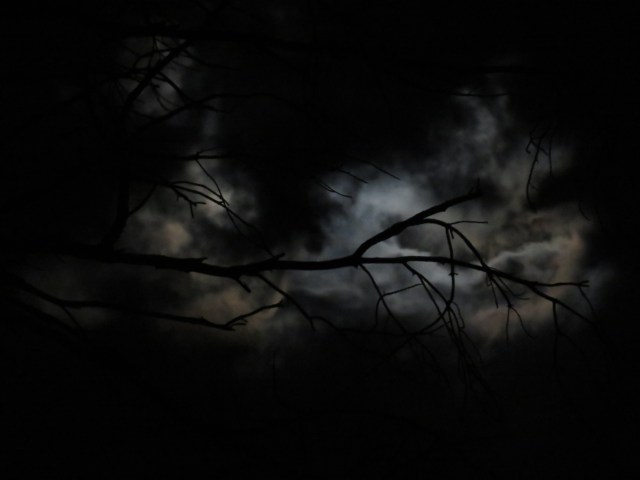
Finally, another photo late at night in the caravan park. The moon was shining through the branches, then disappeared behind some clouds, and I just liked the way it looked:
 Jenny's Adventures
Wonderful stuff
LikeLike
Great pics. Love the uniform, pink suits you both. Nipper’s injury looks so much better now, job well done. Great job with the rescues too xXx
LikeLike
The uniform was pretty funny! And the grebe was pretty interesting, mainly because I didn’t know what it was and spent a long time puzzling over it.
LikeLike