Today, I set off for Evans Head (as you might have guessed, given the title).
There was a turn-off for a bora ring on the way, so I stopped there first, and found it in a small cemetery. Bora rings are raised platforms of dirt to mark sacred places where the Aborigines would perform initiation rites.
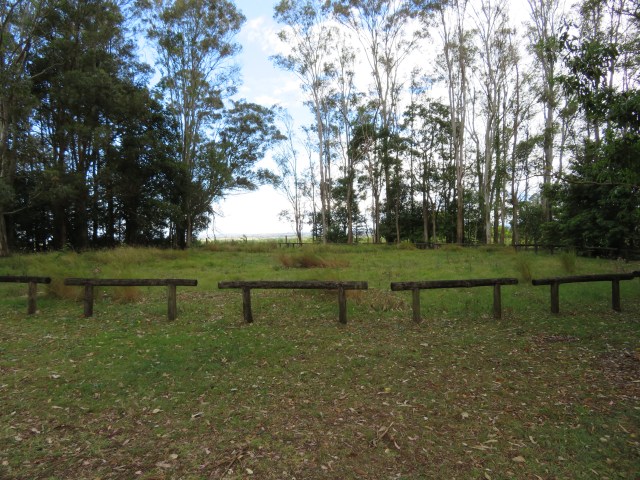
This specific bora ring was for boys being initiated into manhood.
I caught a quick flash of a large bird between the trees, but wasn’t fast enough with the camera. Fortunately, it came into view again over the cemetery, and I realised it was being harassed by two smaller birds.
I managed to get a short video of it – a Spotted Harrier being driven off by two butcher birds.
Then it was on to the F-111 Museum!
The F-111:


And that thing under the wing is not a missile, but an external fuel tank. Because the F-111 goes so fast (top speed of almost a kilometre a second), it burns fuel very quickly. The F-111 has a whole bunch of computers up the front, the cockpit, and everything else is basically fuel. Here’s a diagram showing all the fuel tanks:
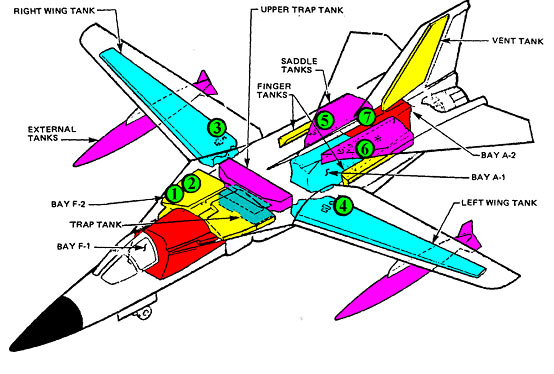
Yeah, there are tanks in each wing and in the tail as well. Pretty crazy, huh?
The F-111 was the first plane to eject a module, not just the pilots. See the seam running under the cockpit and part of the wing?
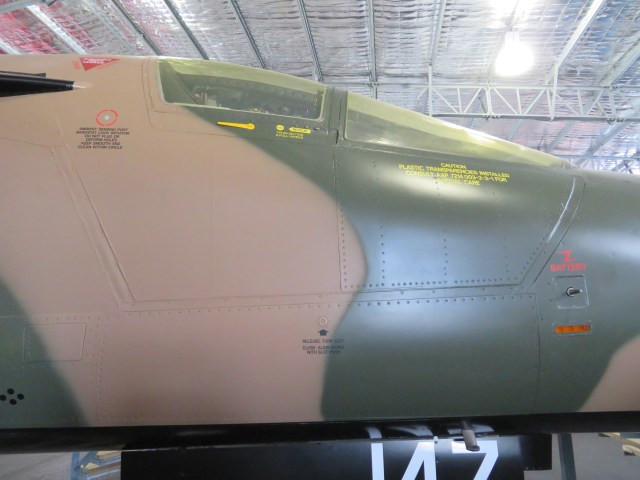
That seam was lined with explosive charges that would be set off when ejection was triggered. The computer would calculate how fast it was travelling and at what altitude, then a guillotine would then come down, severing the control wires. That calculation was then applied to a rocket boost beneath the cockpit that would apply the force needed to hurl the module far enough to avoid the tail of the plane.
Then came the parachute:
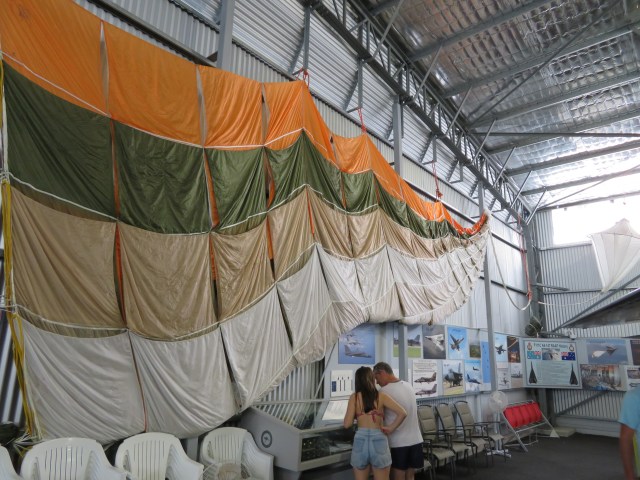
This is the parachute and the drogue parachute – the drogue is the white, kite-looking thing at the edge of the photo. The drogue is deployed first, ensuring the parachute doesn’t open immediately and slam the module into the tail of the plane. The drogue pulls the parachute out, and the force of the pull on the centre of the parachute keeps it collapsed until all forward momentum is lost. Then the drogue line goes slack, and the parachute can open.

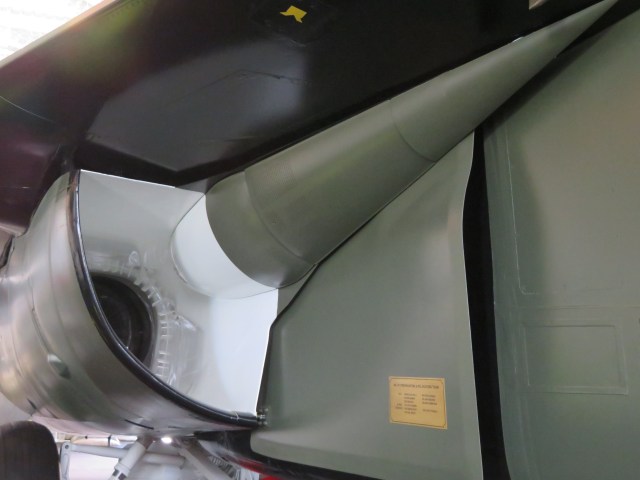
See the way the edge of the tyre sticks out? My tour guide told me the story of how that was invented; three planes were taking off simultaneously in Australia, and the front wheel of one hit a large puddle on the runway. The wheel threw the water up into the turbines, and that was the end of that. So this extra circle of rubber was put on the tyres to direct water further outwards, and the Americans adopted it too.
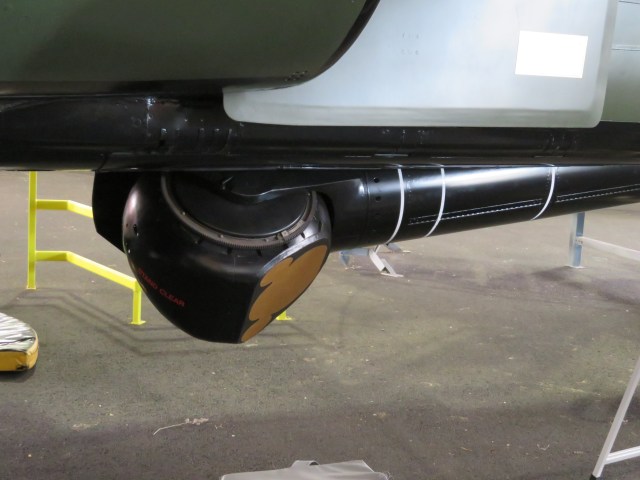
This is where the laser from the ‘laser-guided’ comes from.


This is a flexible pylon that would be attached to the wing and could pivot with the wing. There were two attachment sites on each wing, and each pylon had a capacity of 2.3 tonnes.


The F-111 was the first plane to have no line of sight to the rear, so radar was used to detect threats coming from behind.
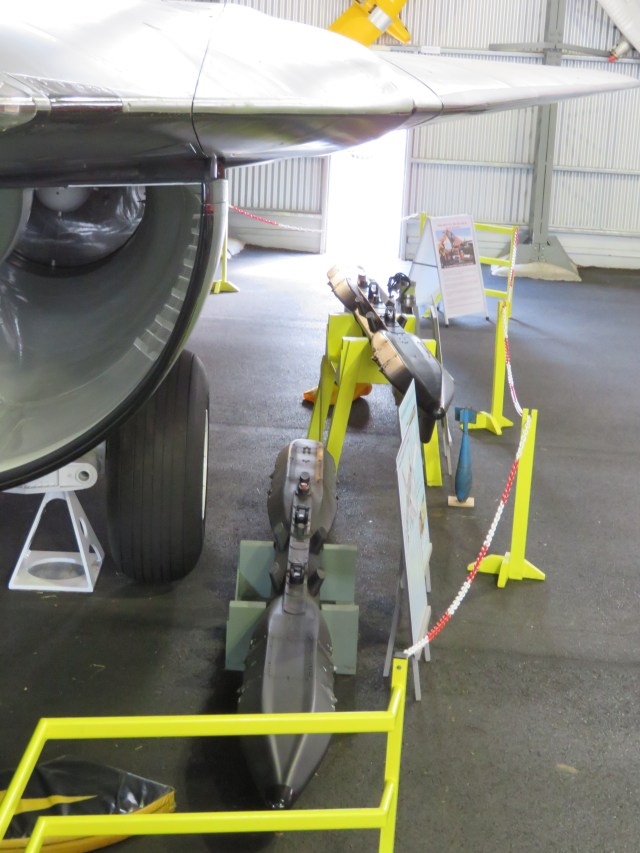
This black thing isn’t a bomb, but what the bombs were attached to. This was attached to one of the flexible pylons, and the bombs were mounted on it.
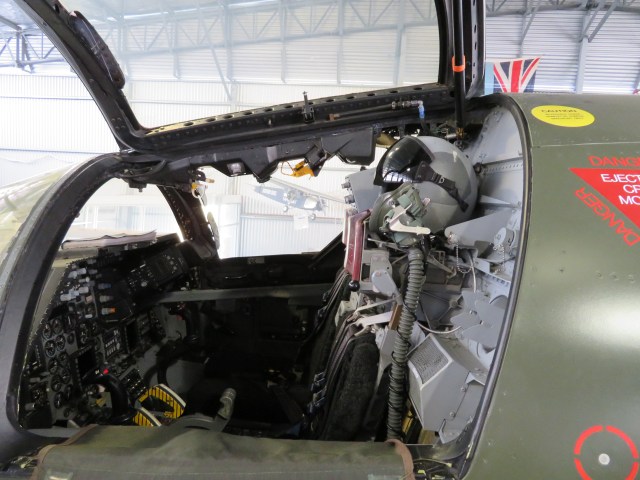
The cockpit, complete with helmet and mask.
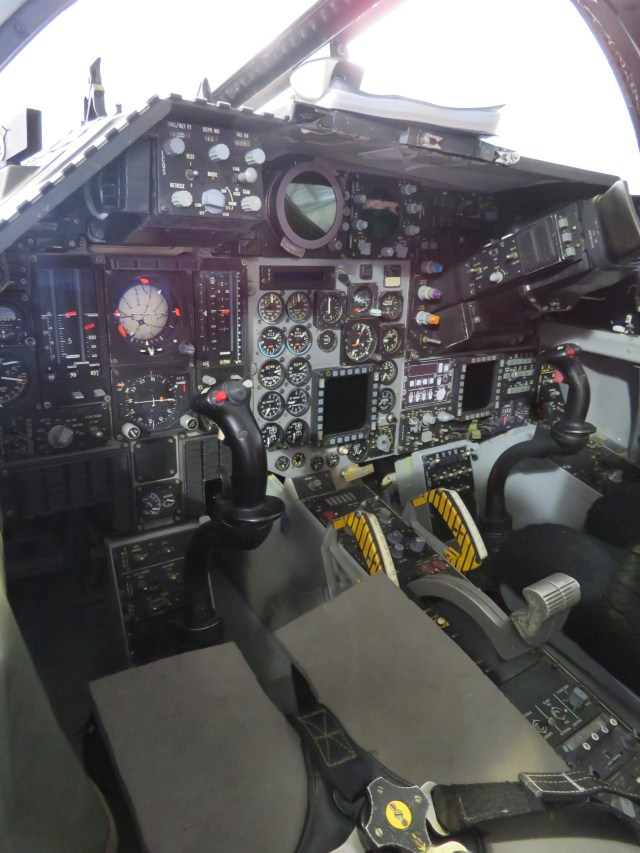
The controls and instrument panels
The two yellow handles placed side by side are ejection triggers. Both will eject the whole module, but there were two put in instead of one because if both people in the cockpit reached for one lever at the same time and collided, it would be instinct to withdraw their hands. So two were built in, to ensure ejection could be triggered exactly when it was needed, with no delay.
I chose to pay for a ‘cockpit experience’ in which I sat in the cockpit and was directed through what everything did. I got to hit switches, turns knobs, and even pull on the throttle! Not that anything happened, but it was still good fun.
Me in the cockpit:


The controls and instrument panels from the seat:


My tour guide used to be an engineer in the army, so he’d flown F-111s as well as fixing them up. He told some amazing stories, and there was a funny one regarding the ‘dump and burn’ that people who’ve been to Riverfire or some aviation shows will know. The fuel is dumped and then ignited in a fiery plume behind the aircraft, and it’s usually done when something’s gone wrong and the plane has to land much sooner than expected. You see, the plane can take off with full fuel tanks, but can’t land with them because that much weight being dropped on the wheels would destroy them. So a dump and burn takes some weight off and makes it safe to land.
Now, Australians do dump and burns as part of shows, but Americans don’t because they consider it too dangerous. But once upon a time, some Australians went to an airshow in Canada. The F-111 pilot put down ‘dump and burn’ on the schedule of stunts he was going to do, but apparently no one knew what it meant, because when he did it the control tower radioed him to make an emergency landing because he was on fire.
He said he was fine, they insisted he wasn’t, so he said he’d prove it was under control and turned it off. Then he said he was going to turn it on again, and started it up.
In the newspapers the next day was a little article about the police taking five hours to clear the nearby highway, because all the drivers had stopped to see what was happening.
Then it was back to Turtle Shell. Lismore is a city of roundabouts, so you’d think people would have a good handle on them, but today I seemed to encounter a lot of drivers who just didn’t grasp it. The person on the roundabout has right of way – even if you’re just turning the corner and I’m going right around, if I’m on the roundabout pulling out in front of me and forcing me to brake is the wrong thing to do. And if you’re on the roundabout, you don’t stop to let me in – you have right of way, keep doing what you’re doing.
Maybe it’s all the Sunday drivers, but I also came close to hitting a motorcyclist on one of the roads up through the hills. They turn some very sharp corners, and I guess this guy wasn’t turning tightly enough because I came around the corner and he was in the middle of my lane, travelling straight towards me! I was going more slowly than usual because of said sharp turns, so I could put on the brakes in time, which was lucky for him – I’m not sure I could have stopped in time if I’d been going the speed limit.
On the bright side, today’s travel really proved that diesel cars are designed for highway driving. My car is not exactly small or light, yet the two-hour roundtrip from Evans Head hasn’t even taken the petrol gauge off ‘full’.
 Jenny's Adventures
Thanks Jen, love the dogfight you witnessed on the way. Good video, and more inter-species aggression 🙂
F-111 pics and story are great. Cya Friday
LikeLike
I was very happy to catch that. If you pause the video you can see more of the harrier. See you on Friday.
LikeLike