Well, there was more than just the koala care centre, but that’s the really interesting part.
I actually woke up thinking I was back home in Brisbane – I blame the birds! Noisy minahs and rainbow lorikeets abound in the park, so it sounded very much like the birdsong of home.
It rained during the night, but was still overcast this morning, getting a humid and sticky as the day went on. I found myself periodically turning on the air con in the caravan for five minutes just to suck the moisture out of the air.
First up on the agenda today was a stroll around town – some historic walks the tourist information recommended.
I passed an enormous, mechanical butter churn, that used to belong to the Norco company.


And apparently these nice, rolling hills are actually the flood levee. Good plan, really – Brisbane could have used a few more of these back in 2011.
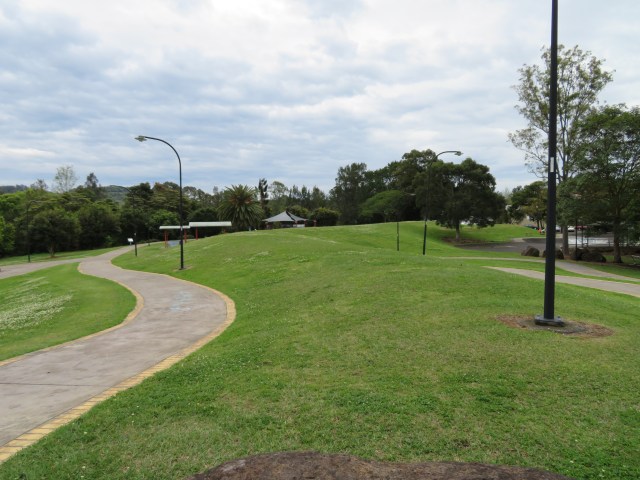
I can just see an advert for these: “flood defense has never looked so appealing.”
There were some interpretative panels talking about the Aboriginal and European history of Lismore and the surrounding countryside.
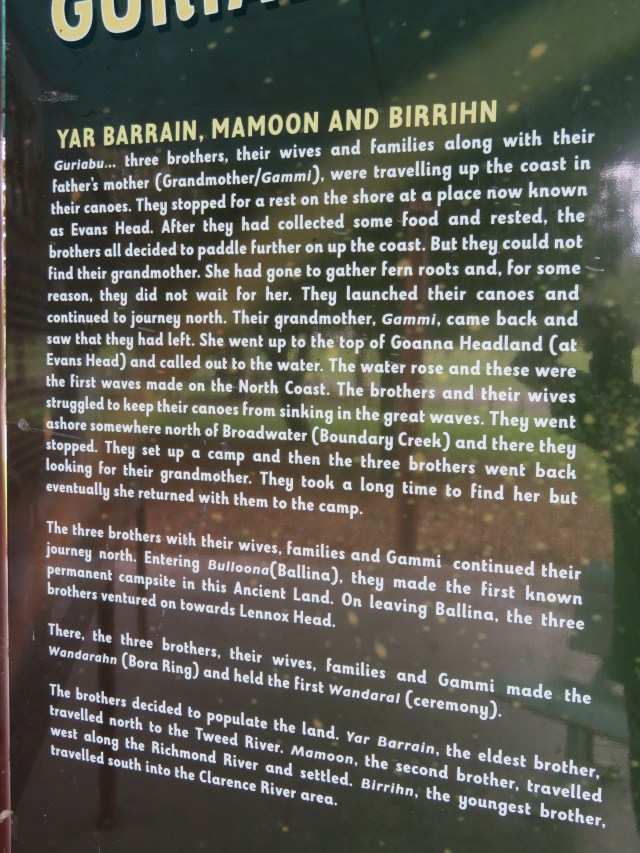
Photo of a panel describing an aboriginal legend about how their people first settled here.
Now, prepare for an info dump of some facts I found interesting:
- A fair amount of Indians apparently emigrated to the Lismore area, working in the sugar industry. They couldn’t work in the dairy industry though – they were said to have leprosy that would contaminate the milk, and Norco warned farmers that if they employed Indian workers, their milk wouldn’t be bought. As I was learning about this, I have a bottle of Norco milk in my fridge.
- The Big Scrub used to be the largest area of lowland subtropical rainforest in Australia, covering 75, 000 hectares and stretching north from Lismore all the way to Nightcap Range, and east to Ballina and Byron Bay. The government granted land to whoever cleared it for agriculture, so now less than 1% of the rainforest is left. I’ll be seeing some of the remnants in the days to come.
- Lismore itself takes its name from Lismore station, owned by the Wilson family, who formed the first permanent pastoral settlement where the city is today in 1845. It was the lady of the household, Jane Wilson, who actually called it Lismore, after the Island of Lismore in Loch Linnhe, Scotland. Why this place reminded her of Scotland, who can say?
- Bundjalung was the collective name given to the three aboriginal tribes that used to inhabit the Big Scrub. One of the conflicts between the Bundjalung and the white settlers was the belief that the Bundjalung would kidnap white children. What actually happened was that isolated station children would usually play with the children of the local tribe, and because the Bundjalung believed that any child born in the ‘Country’ was also Bundjalung, if it was time to move on and the while child was still with them, the kid would simply be adopted into the group.
- William Wilson (whose wife named Lismore) developed a lifelong relationship with Charles Queybaum, a Bundjalung leader, where enough mutual obligation remained to bring relative peace to the area.
- The owners of Tunstall Station and Runnymede Station fought each other to bankruptcy over a parcel of land near Bentley. The area is still known as Disputed Plain. This amused me.
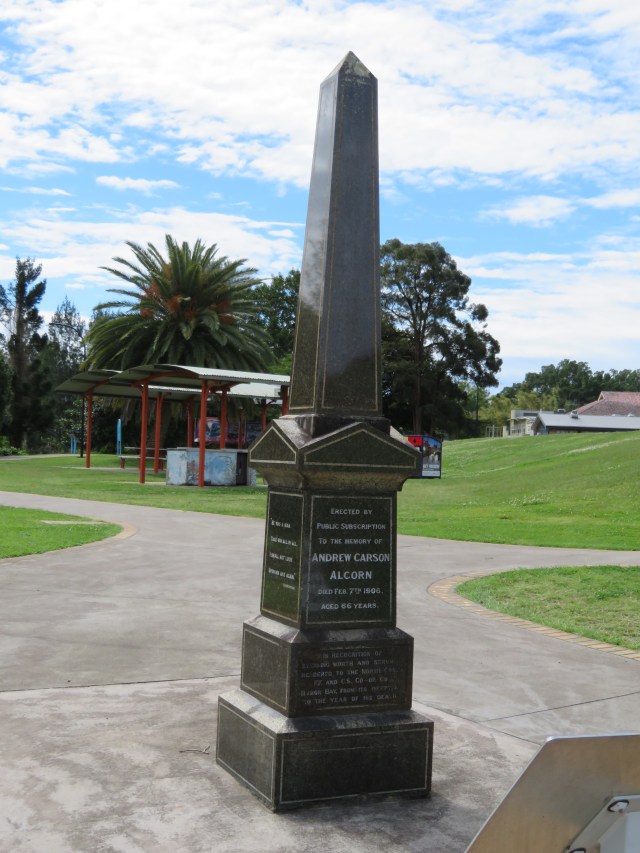
An obelisk dedicated to Andrew Alcorn who, as part of a farming cooperative, sold the greatest amount of shares to establish the Norco company. He was called ‘the father of the creamery’.
Also, I learned that the original name in 1893 was the North Coast Fresh Food and Cold Storage Co-operative Company Limited. It was shortened in 1904 to North Coast Co-operative Co Ltd. Norco was originally the name of the butter they produced, but it became the official company name in 1926. Stories like that are always bizarrely interesting to me.
The walk took me through a bush food garden, but it was rather disappointing as it didn’t seem well-tended – there were plants, but very few signs indicating what you were looking at.
Now for some historic buildings:
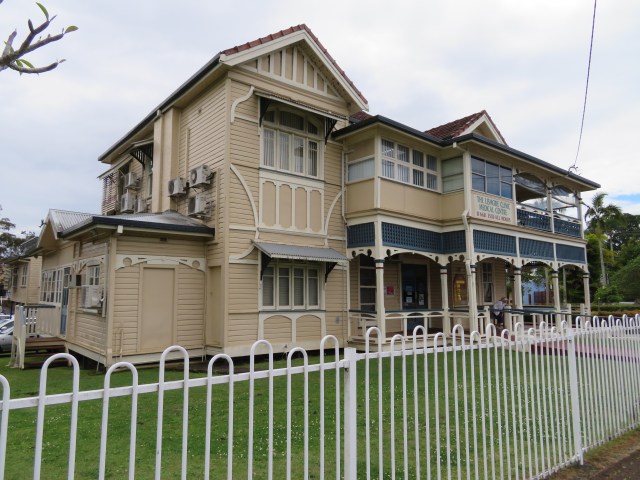
The medical clinic
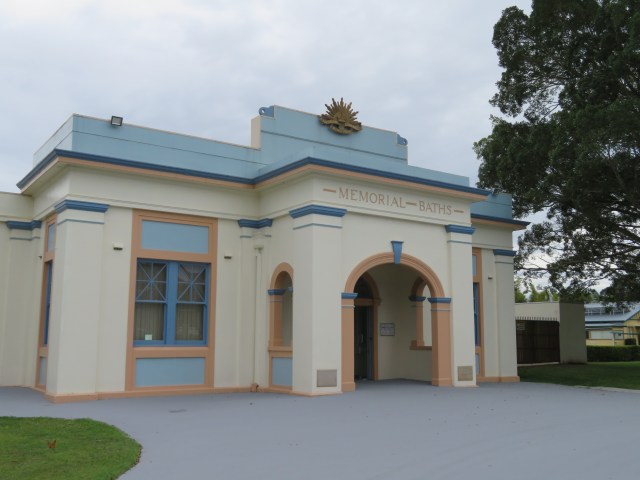
The memorial baths
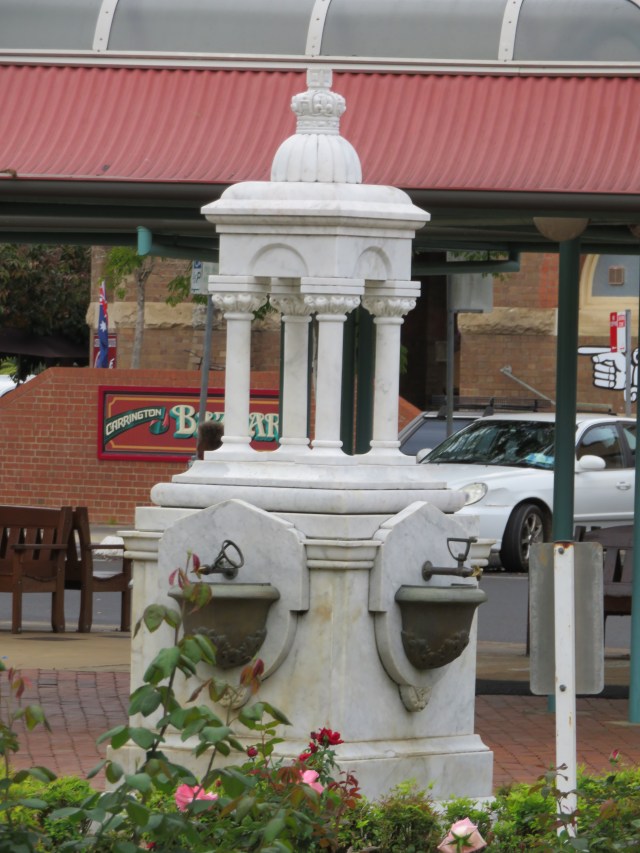
Queen Victoria Fountain
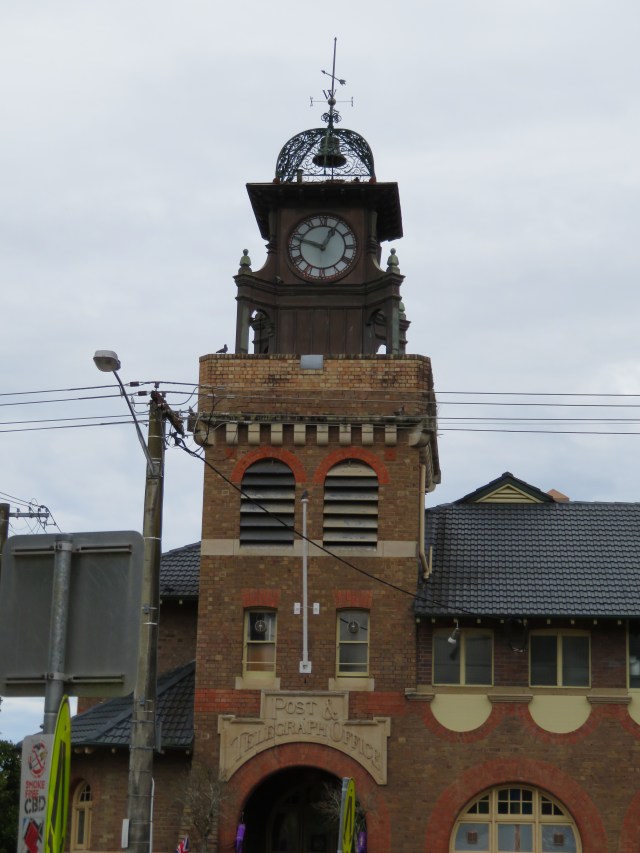
Post and telegraph office
I also wandered down a place called back alley gallery, where lots of street art is on display. Here are some of the best ones:


I had some lunch, and went back to where I’d parked the car. I passed a small fish and chip shop and a pie cart on the way, and it was a good thing I’d already had my sandwich or a I would have spent some money – they both smelled so delicious!
Then it was off to the koala care centre. They’re near the university, and serve the whole Clarence River area, but they rely on donation and volunteers.
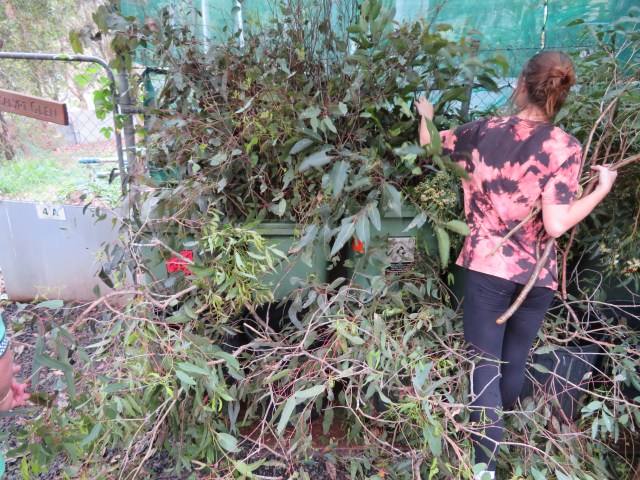
All the eucalyptus leaves for feeding the koalas.
Apparently koalas have favourite ‘flavours’ of eucalyptus – the most popular among these koalas is the redgum, followed by swamp mahogany.
I also learned that koalas up here are smaller than the ones down in Victoria. Females up here tend to be around 6kg, males around 10kg, but in Victoria the females are 10kg and the males are 15kg. Quite a difference, probably because its much colder down south. They’re furrier too, or so my tour guide said.
I didn’t have a chance to pet them, more’s the pity, because it’s a care centre and most of them have something wrong with them.
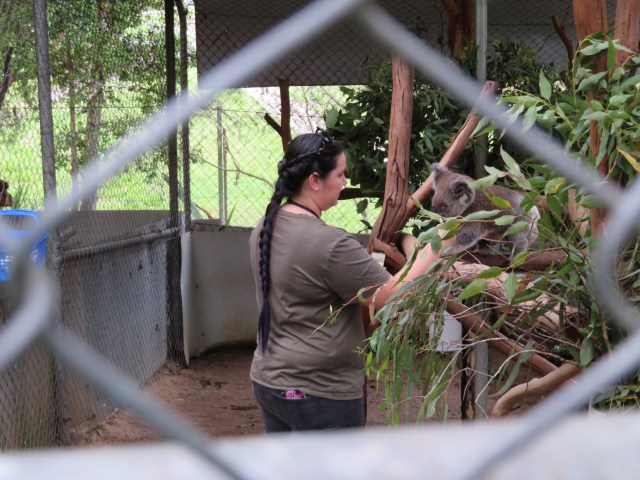
My tour guide, Yasmin, and the koala, Sweetie.
Sweetie was being given a syringe of soy milk mixture to give her more protein to help her build up weight. The koalas are also given multivitamins and iron supplements while they’re in care.
Sweetie was kind of a special case – she’d been an orphan, but when she was released she just did very badly, and started dropping weight as soon as she was on her own. They brought her back in, fed her back up, and then it happened all over again when she was released.
They call it ‘failure to thrive’ and apparently it can happen as a result of activation of a retrovirus. Essentially, koalas have a virus lurking in their DNA, and it can be activated in times of stress (like being orphaned or hit by a car) and it compromises their immune systems. Imagine if, every time something traumatic happened, you had a chance of developing AIDS. Sometimes the dicey nature of evolution really screws some species over.
Because the virus is part of their DNA, there’s no test developed yet that can tell whether it’s active or not, but the volunteers suspect Sweetie might have it, which would explain why she does fine when she’s given food and kept in a relatively clean environment, but fails in the wild.
The other patients I got to see are Lucinda and her baby, Thumbelina. Here’s a short video I took of them:
They were in because Lucinda was 13 years old, an age which wild koalas rarely reach, and they’re not supposed to be breeding at that point. It’s like a human woman having a baby at 60 – it can technically be done, but she’s going to need some help with the pregnancy and care.
I headed back to Turtle Shell to drop my things off, and then went for a short walk around the caravan park. This is the first time I’ve been in a ‘city’ park, so I thought I’d look around and play ‘spot the permanent residents’. I found three that definitely didn’t look transient.
I’m not claiming to be an expert, but these seem to be the criteria:
- Caravans that look a bit rusty around the edge and not really ‘roadworthy’. If they’re caravans at all – someone here lives in a disused bus.
- A very large, complex annex, well-secured and water-tight, with lots of stuff in. The people who live in the bus have a full-sized fridge, cupboard, barbecue and lounge chairs in theirs.
- These don’t seem to be constant, but a lot of the permanents seem to have pot plants and little garden statues outside.
I suppose it makes sense, in a way – it might be in the realm of $400 a month, but there’s no power or water bills. And I got a weekly discount rate, so there’s probably a monthly discount rate as well.
Well, that’s it for today, hopefully tomorrow is dry enough for me to go see the botanical gardens, but we’ll see how that goes.
 Jenny's Adventures
I’m sure I’ve seen a couple of the buildings, but had no clue about the back street art (how good was that) or the koala care place! More things for my list. xx
LikeLike
I’m sure you have – you’d remember our visits to Lismore a lot better than I would.
LikeLike